What Is “High-Engagement Curriculum,” Really? It’s not just “fun worksheets.”It’s curriculum designed with: Interactivity (QR codes, puzzles, real-world tasks) Modern visuals (clean layouts, color-coded sections) Scaffolding (step-by-step explanations students can actually follow) Real-world scenarios (budgeting, investing, careers, coding challenges) Student autonomy (spaces to think, explore, try, fail, retry) Basically, it’s learning that feels like it...
Schools & CurriculumWhy High-Engagement Curriculum Helps Students Learn Faster

What Is “High-Engagement Curriculum,” Really?
It’s not just “fun worksheets.”
It’s curriculum designed with:
-
Interactivity (QR codes, puzzles, real-world tasks)
-
Modern visuals (clean layouts, color-coded sections)
-
Scaffolding (step-by-step explanations students can actually follow)
-
Real-world scenarios (budgeting, investing, careers, coding challenges)
-
Student autonomy (spaces to think, explore, try, fail, retry)
Basically, it’s learning that feels like it belongs in 2025, not 2005.
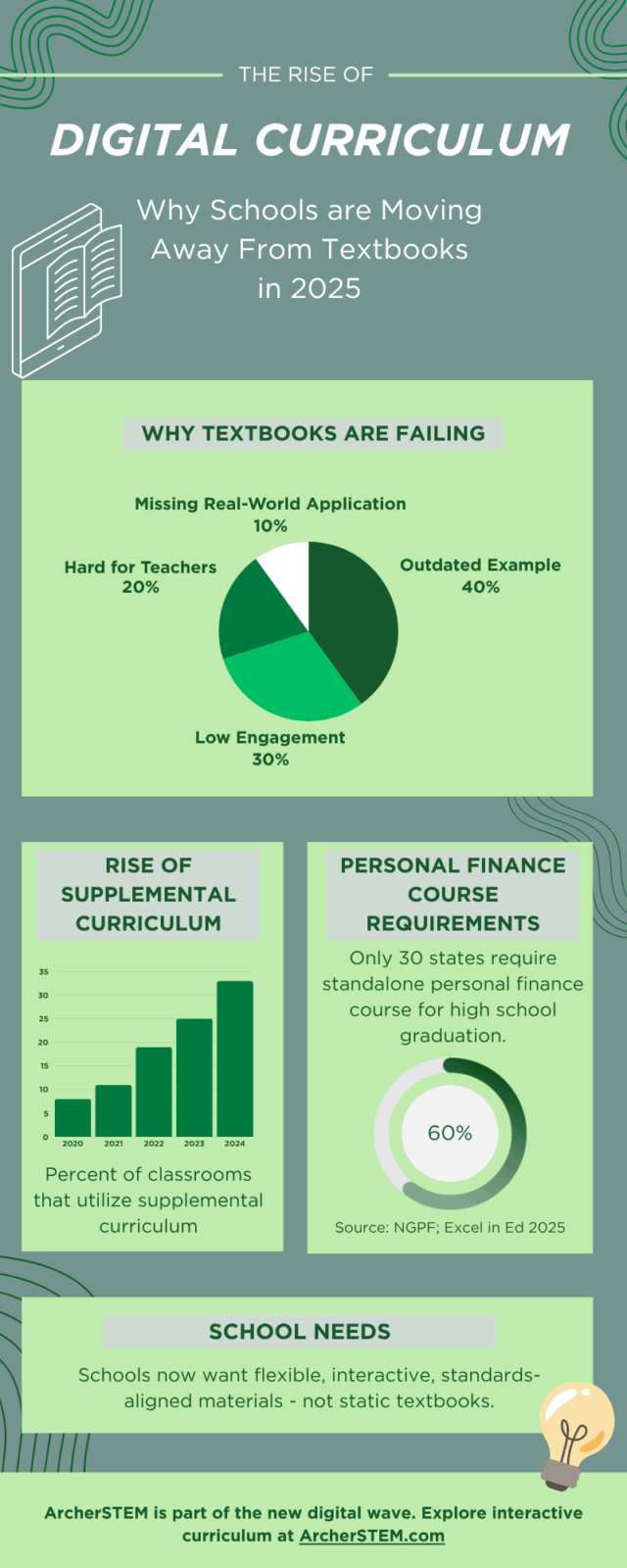
And yes — the engagement piece directly impacts achievement.
Why Engagement = Higher Mastery
(This isn’t a cute trend — it’s neuroscience.)
According to the Journal of Neuroscience, students retain up to 34% more information when learning is combined with activities that require novelty, emotion, or interaction.
Harvard’s Center on the Developing Child explains that the brain literally “lights up” when something is:
-
new
-
challenging
-
visual
-
or requires decision-making
Meaning?
Engagement isn’t fluff. Engagement is cognition.
And when curriculum keeps students mentally active, mastery comes faster.
1. Engagement Boosts Retention (by a LOT)
The National Training Laboratory Learning Pyramid (yes, the chart you’ve seen everywhere) shows:
-
5% retention from lectures
-
10% from reading
-
75% from doing
-
90% from teaching or creating
Now imagine a workbook where students:
-
Watch a short animation via QR code
-
Complete an interactive activity
-
Solve a real-life scenario
-
Explain the concept in their own words
That’s not just a worksheet — that’s a retention machine.
2. Students Build Real-World Confidence
High-engagement curriculum includes tasks like:
-
Building a mock budget
-
Analyzing real credit reports
-
Writing actual JavaScript code
-
Planning a business
-
Solving math within real-life contexts
This builds transferable skills, not just test skills.
A 2023 EdWeek Research Center report found that 82% of teachers believe real-world activities increase student confidence more than traditional instruction alone.
Confidence → Participation → Mastery.
A perfect chain.
3. Teachers Save Time (and sanity)
Teachers are drowning in:
-
pacing guides
-
lesson planning
-
differentiating work
-
reteaching fundamentals
-
managing behavior
-
finding materials
High-engagement curriculum solves this because it:
-
Is already scaffolded
-
Includes step-by-step examples
-
Supports visual, kinesthetic, and auditory learners
-
Reduces off-task behavior
-
Helps students work independently
-
Comes with teacher resources (slides, pacing, extra practice)
In short?
Teaching becomes easier and more joyful.
And yes — when students are engaged, classroom management becomes way less stressful.
4. It Helps Close Learning Gaps Faster
One of the biggest issues teachers report:
“Students are missing foundational skills.”
High-engagement curriculum helps because:
-
The visuals make concepts clearer
-
Explanations are chunked
-
Practice is leveled (easy → medium → challenging)
-
Students get immediate feedback
-
Activities force them to think, not memorize
According to the Annenberg Institute at Brown University, schools that use high-engagement materials see 20–45% faster gains in math fundamentals.
This is huge.
5. It Matches What States & Colleges Want
This part is underrated.
States (NJ, NY, PA) are shifting toward:
-
Modern learning experiences
-
Digital literacy
-
Financial literacy mandates
-
Coding requirements
-
Project-based learning
The College Board has updated AP CS, SAT Math, and career education standards to include:
-
problem solving
-
modeling
-
real-world applications
High-engagement curriculum isn’t optional anymore.
It’s aligned with where education is going.
So What Does This Look Like in a Classroom?
Picture this:
Your students open their workbook.
They scan a QR code.
A short animation explains the concept.
Next page:
A step-by-step breakdown.
Then:
A puzzle, simulation, or real scenario.
Then:
A practice section with color-coded hints.
Then:
A challenge problem that feels like a game.
They’re learning… without fighting it.
And the teacher?
They’re not begging anyone to focus.
That’s the power of design that respects how the brain learns.
Why I Created the ArcherSTEM Workbooks
I created these workbooks because I got tired of seeing kids:
-
intimidated by math
-
bored out of their minds
-
capable but unsupported
-
missing foundational skills
-
wanting to understand why, not just how
And honestly?
I wanted tools that felt modern, beautiful, and easy to use.
Not packets.
Not worksheets.
Not 80s clipart.
Real curriculum that teaches — and excites.
Check out the Intro to Coding Workbook, Financial Literacy Workbook, or Algebra 2 Workbook — all designed to help students learn faster with confidence.