If you’ve walked into a school recently—whether as a parent, teacher, or student—you may have noticed a shift. Fewer support staff. Larger class sizes. Teachers juggling roles they were never hired for. And every time someone asks, “Why is everything so stretched thin?” the answer is almost always the same: “We don’t have the budget.”...
Teacher TrainingWhen School Budgets Shrink: How Cuts Affect Students, Teachers & Learning in 2026

If you’ve walked into a school recently—whether as a parent, teacher, or student—you may have noticed a shift. Fewer support staff. Larger class sizes. Teachers juggling roles they were never hired for.
And every time someone asks, “Why is everything so stretched thin?” the answer is almost always the same:
“We don’t have the budget.”
In 2025, thousands of schools across the U.S. are facing a financial cliff. And the truth is… most families don’t realize how deep the issue goes until something breaks.
Let’s talk about why budgets are shrinking, what that actually means inside a real classroom, and the everyday ripple effects students feel—whether they’re in Pre-Algebra or prepping for the SAT.
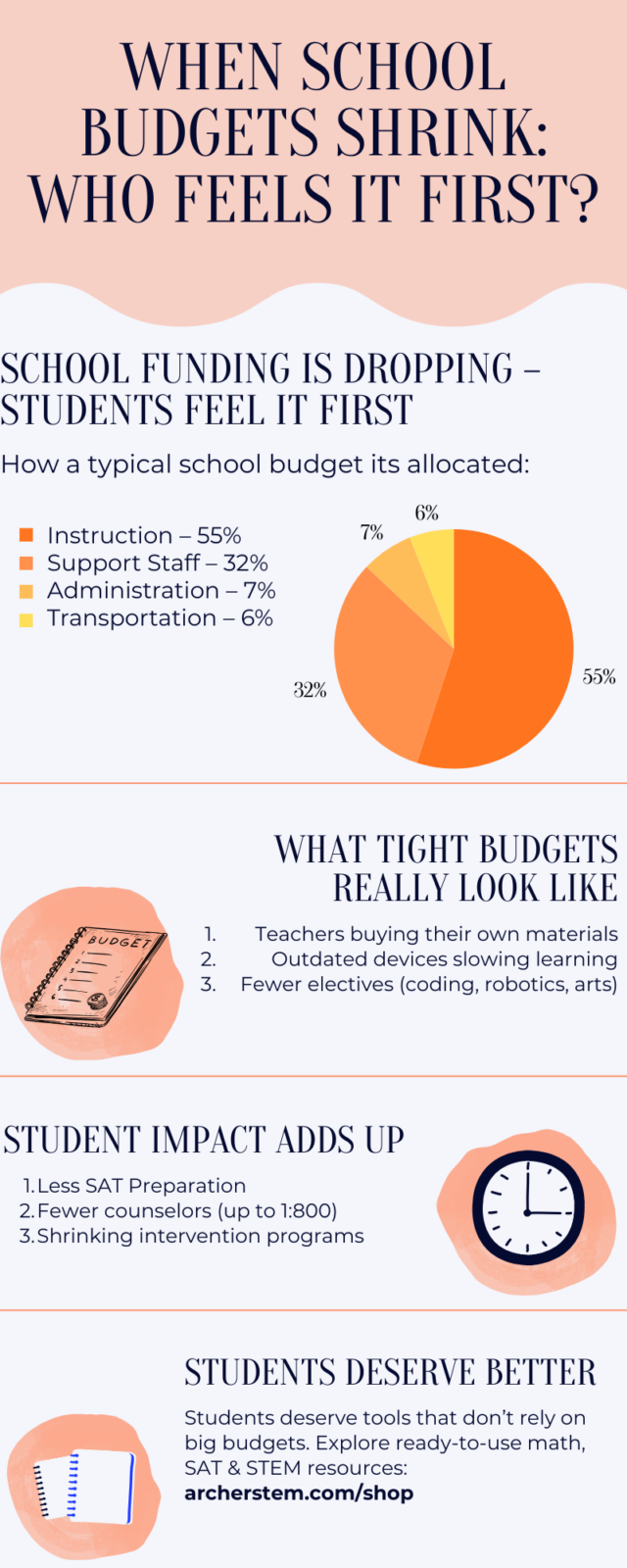
Why School Funding Is Shrinking in 2025
The main reason for the squeeze is simple:
The federal ESSER (COVID relief) money is gone.
Between 2020–2023, schools received more than $190 billion in emergency funding to recover from the pandemic (source: U.S. Department of Education).
Schools used that money to:
-
hire temporary teachers and tutors
-
update technology
-
expand counseling
-
add after-school programs
-
buy devices and hotspots
-
support learning loss intervention
Now?
That money has expired.
And districts are left holding long-term expenses with no long-term funding.
Many states haven’t increased school budgets to match inflation, either. So schools are paying more… with less.
Who Feels the Cuts First? Teachers. Always teachers.
Here’s the part no superintendent wants to say out loud:
Teachers personally fill the gaps long before the public notices the cuts.
According to the National Education Association, the average teacher spends $820 of their own money per year on supplies. When budgets shrink, that number goes up… because kids still need pencils, notebooks, calculators, tissues, everything.
Common impacts teachers feel:
✔ Larger class sizes
When schools can’t afford more staff, teachers get 28, 30, even 35 students per class.
✔ Outdated or slow technology
Computers that freeze. Chromebooks that barely charge.
It’s not laziness—it’s budget reality.
✔ Reduced planning time
Staff cuts = fewer aides = teachers covering more supervision duties.
✔ Less curriculum support
Schools can’t afford updated materials, so teachers are piecing together lessons from multiple outdated sources.
And when teachers are exhausted, overwhelmed, and unsupported… students feel it next.
How Students Are Impacted (This Is Where It Gets Real)
Budget cuts don’t show up as one big dramatic moment.
They show up in quiet ways:
1. Fewer electives
Goodbye robotics, culinary arts, computer science, photography.
Electives are often cut first because they aren’t “core.”
2. Less STEM access
Coding classes? Robotics clubs?
Those require equipment, devices, and trained teachers—meaning they’re usually the first to disappear.
3. Outdated SAT prep resources
Many schools rely on old test-prep books from the previous decade.
This matters because the SAT changed drastically in 2024.
4. Counseling overload
Counselors in some districts are now responsible for 600–800 students each (source: American School Counselor Association).
5. Fewer intervention programs
Reading specialists, math interventionists, and after-school tutors are often grant-funded.
When funding ends—so do the programs.
6. Special education services get squeezed
SpEd legally must be funded… but cuts often mean fewer aides and less support time.
In short:
The cuts hit the students who need support the most.
The Long-Term Academic + Emotional Impact
This part is uncomfortable, but necessary.
When schools lose funding:
Achievement gaps widen
Low-income students fall further behind.
Graduation rates drop
Fewer supports → more students giving up.
College readiness declines
Without strong math, reading, and SAT preparation, students walk into exams underprepared.
STEM pathways become less accessible
Fewer coding classes = fewer students entering high-paying STEM careers later.
Teacher turnover spikes
More than 55% of teachers say they’re considering leaving the profession (source: NEA, 2023).
A school system can’t function when the people running it are burning out.
What Schools Can Do (Even on a Tight Budget)
While funding isn’t magically appearing, districts do have options:
✔ Apply for grants
– STEM, literacy, career education, and wellness grants are still widely available.
✔ Build community partnerships
Local nonprofits, after-school programs, and community colleges often help fill learning gaps.
✔ Use low-cost digital resources
This is where companies like yours shine — interactive, accessible resources that don’t require overpriced textbooks.
✔ Prioritize evidence-based instruction
Better teaching → better outcomes → more grant opportunities.
✔ Advocate publicly
Parents have more power than they realize.
School boards listen when families show up.
We created these workbooks because schools kept telling me the same thing:
“We want to give students more… but we don’t have the budget.”
So I built resources that:
-
work in ANY classroom
-
are affordable
-
support students independently
-
reduce teacher workload
-
bridge learning gaps in math, SAT prep, coding & financial literacy
Schools don’t need more pressure.
They need practical tools.
And students deserve resources that feel modern, engaging, and confidence-building—not outdated worksheets that don’t match real-world skills.
Want Ready-to-Use Support for Your School?
Here are some tools teachers and parents love:
📘 Algebra 2 Workbook
https://archerstem.com/product/alg-2-workbook/
📘 SAT Math Workbook
https://archerstem.com/product/sat-math-workbook/
📘 Financial Literacy Activity Workbook
https://archerstem.com/product/financial-literacy-activity-workbook/
📘 Intro to Coding Workbook (Java)
https://archerstem.com/product/intro-to-coding-workbook/
📦 High School Bundle
Perfect for schools that need multiple subjects covered on a tight budget.
https://archerstem.com/product/high-school-bundle/
Learning shouldn’t suffer just because budgets shrink.
You’re here because you care—and that already makes a difference.