If you’ve stepped inside a public school lately, you might’ve noticed a very specific aesthetic:“Educational excellence meets DIY survival mode.” Markers that barely write.Computers that sound like they’re powering a small aircraft.Teachers whispering silent prayers at the copy machine. We joke about it, but it’s not really funny. Schools across the country are bracing for...
Teacher TrainingWhen Funding Disappears: What Really Happens When School Budgets Are Cut
If you’ve stepped inside a public school lately, you might’ve noticed a very specific aesthetic:
“Educational excellence meets DIY survival mode.”
Markers that barely write.
Computers that sound like they’re powering a small aircraft.
Teachers whispering silent prayers at the copy machine.
We joke about it, but it’s not really funny. Schools across the country are bracing for one of the most significant funding drops in recent years — not because anyone did anything wrong, but because the federal support that temporarily held districts together has officially run out. According to Education Week, schools are facing the loss of more than $60 billion in emergency ESSER funding, which kept programs, staff, and technology afloat during the pandemic years. And unlike most budget gaps, this one doesn’t come with a replacement plan.
So what actually happens when the Department of Education — and state governments — begin tightening school budgets? A lot more than people think.
The Quiet Domino Effect Nobody Talks About
The first misconception people have is that budget cuts only affect “extras,” like after-school clubs or field trips. In reality, cuts hit the foundation first. Most school budgets are already tightly allocated to fixed costs like transportation, building maintenance, benefits, and mandated services. When money shrinks, schools can’t cut the non-negotiables — so they start trimming in places students and teachers feel directly.
One big driver of budget strain right now is declining enrollment. The National Center for Education Statistics reported a 3% drop in public school enrollment since the pandemic. Fewer students means less funding in states that use per-pupil formulas. Add inflation, rising transportation costs, increased mental health needs, and outdated buildings, and districts are being squeezed from all sides.
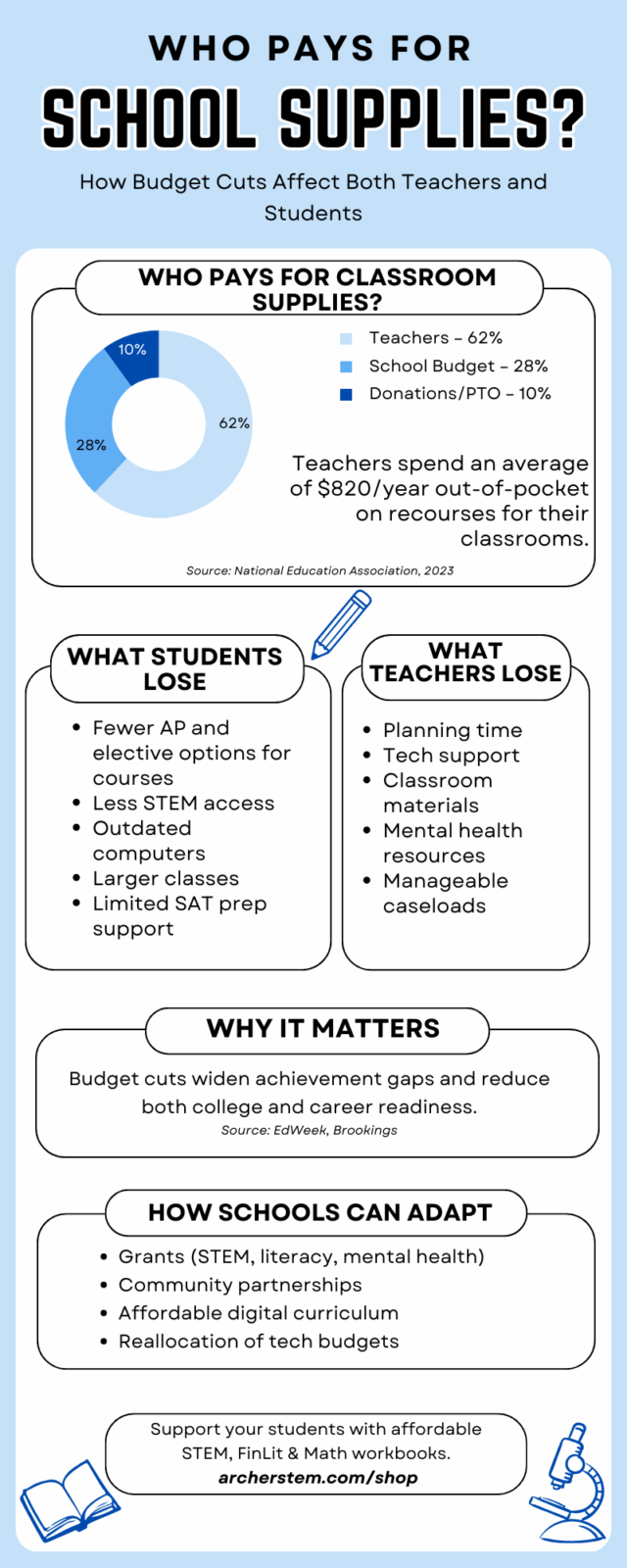
Teachers feel it first. They always do. The NEA found teachers now spend an average of $820 of their own money per year on supplies — and many spend over $1,000. When budgets shrink, those unspoken expectations grow. Instead of being given basic materials, teachers quietly pick up the slack, because the alternative is letting kids fall behind.
And then there’s class size. Larger classes aren’t just inconvenient; they have measurable consequences. The Brookings Institution notes that when class sizes push past the high 20s, student achievement, engagement, and classroom behavior all take a hit. When schools can’t hire enough staff, those numbers can climb quickly.
How Students Feel It (Even When They Don’t Realize It)
The most heartbreaking part is this: students often don’t realize they’re being shortchanged. They adapt. They make jokes about the broken laptop cart or old textbooks, but those limitations shape their academic future more than they know.
Technology becomes outdated. Computer science and robotics programs shrink. Counselors end up responsible for 600–800 students at once (the American School Counselor Association recommends 250 max). Electives disappear. Art and music become “luxuries.” AP offerings thin out. Even SAT prep opportunities diminish — and the College Board has repeatedly acknowledged that access to digital tools directly affects SAT math performance.
Schools don’t just lose convenience — they lose pathways.
And the effects are long-term. A Stanford Center for Education Policy Analysis study found that students who go through budget-cut years experience lower achievement gains, especially in math and reading. Cuts don’t just make a year harder — they alter a student’s trajectory.
The Systemic Problems That Snowball
All of these micro-impacts stack up into something bigger. Schools experiencing cuts often see:
-
lower test scores and graduation rates
-
higher teacher turnover and burnout
-
widened achievement gaps between affluent and low-income communities
-
less access to advanced coursework and career/college prep
These aren’t abstract statistics. These are real families, real teachers, real kids — many of whom already face barriers outside of school. A shrinking budget becomes another barrier layered on top of the existing ones.
And here’s the part people forget: once a program disappears, it is incredibly difficult (and often expensive) to bring it back. A cut to robotics today means fewer STEM majors tomorrow. A cut to financial literacy now means adults who struggle with credit, saving, and investing later on. These ripple effects last far beyond a single school year.
So… What Can Schools and Families Actually Do?
Here is where some hope comes in — because communities are stepping up in big ways. Yes, budget cuts are real and painful, but they don’t mean “game over.” They just mean the strategy needs to shift.
Schools are increasingly turning to grants (there are hundreds — from STEM initiatives to arts programs), community partnerships with nonprofits and businesses, and affordable digital tools to fill the gaps. The National Science Foundation, state-level STEM councils, and numerous private foundations offer support many districts haven’t tapped into yet.
And digital curriculum is becoming a lifeline. Not because it’s trendy, but because it’s sustainable. Schools can’t always afford new textbooks or entire programs, but they can afford reusable, interactive digital resources that serve multiple grade levels over multiple years.
That’s one of the reasons I created ArcherSTEM — because even in a low-budget environment, students should still have access to high-quality, rigorous math, STEM, and financial literacy materials. Budget cuts shouldn’t determine which students get exposure to coding or which teens learn how credit scores work.
Families also have power. Advocating at school board meetings, supporting grant-writing efforts, voting in local elections, and supplementing learning at home makes a measurable difference. And honestly, sometimes it starts with a simple question:
“What does this school need that it isn’t getting?”
Every strong community begins with awareness.
A Personal Note (And Why I Care About This So Much)
Budget cuts frustrate me because I see what students are capable of when they’re supported. I’ve watched students thrive the moment they finally had access to the right tools — and I’ve watched others struggle simply because their school couldn’t afford the basics.
ArcherSTEM was born from the belief that learning should be accessible, affordable, and engaging — not dependent on whether a district’s budget happens to be in good shape this year.
If your school or program is looking for ready-to-use, low-cost STEM, SAT, or financial literacy materials, I’d love to support your students, your teachers, and your community.
Want Classroom-Ready Materials That Don’t Break the Budget?
Here’s where to start:
-
Financial Literacy Activity Workbook
https://archerstem.com/product/financial-literacy-activity-workbook/ -
Algebra 2 Workbook
https://archerstem.com/product/alg-2-workbook/ -
SAT Math Workbook
https://archerstem.com/product/sat-math-workbook/ -
Pre-Algebra Workbook
https://archerstem.com/product/pre-alg-workbook/
Or browse everything:
https://archerstem.com/shop
Students deserve the best — with or without a big budget.