STEM Education in Crisis: Why the U.S. Feels Behind (and What We Can Do) Let’s be real — we talk about how important STEM is almost every week.But when it comes down to test scores, engagement, and actual results, the U.S. still trails behind many countries in math and science. So what’s going on here?...
Teacher TrainingSTEM Education in Crisis: Why the U.S. Feels Behind (and What We Can Do)

STEM Education in Crisis: Why the U.S. Feels Behind (and What We Can Do)
Let’s be real — we talk about how important STEM is almost every week.
But when it comes down to test scores, engagement, and actual results, the U.S. still trails behind many countries in math and science. So what’s going on here? Why are we still having the same conversation year after year while Finland, Singapore, and South Korea quietly crush the rankings?
I dove into the research (yes, the nerdy reports) — and the data tells a story that’s hard to ignore.
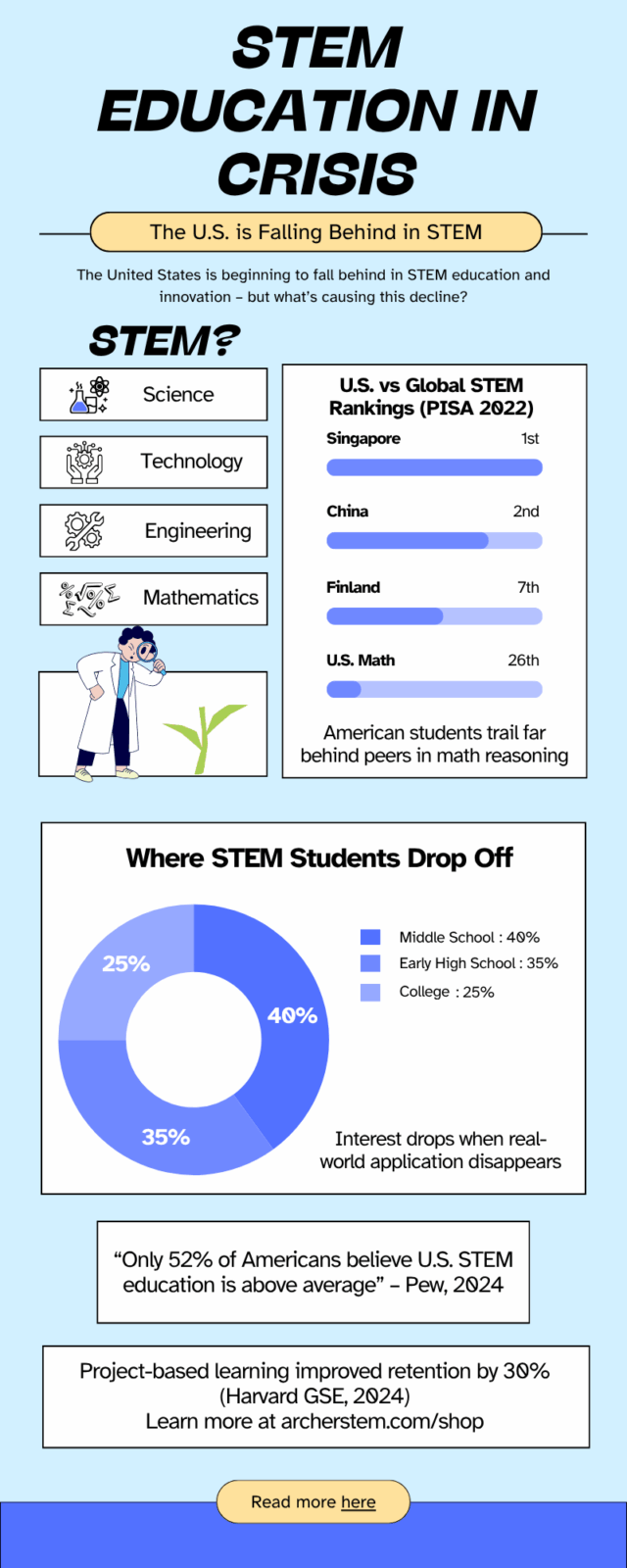
The Numbers Don’t Lie
According to the Pew Research Center (2024), only 52% of Americans believe the U.S. ranks above average in K–12 STEM education globally — and they’re not wrong. The OECD’s 2022 PISA results show that American 15-year-olds rank 26th in math and 13th in science out of 79 participating nations.
That’s… not great. Especially for a country known for producing the world’s top tech companies and research universities.
The National Science Foundation (NSF, 2024) points out a deeper issue: the gap between high-performing and low-performing students is wider here than in almost any other developed nation. Translation? Our system isn’t equitable. Talent is everywhere; opportunity isn’t.
The Real Problem: Rote Over Reasoning
American classrooms often still emphasize memorization — formulas, facts, and test prep — rather than problem-solving.
When a student can recite the quadratic formula but can’t explain what it means, we’ve trained a calculator, not a thinker.
In countries leading STEM performance, like Singapore, the focus is on conceptual understanding and metacognition — the art of thinking about your own thinking. The National Academies of Sciences (2023) highlighted that active reasoning and self-questioning improve retention and transfer of math and science skills far better than rote practice.
So when you see your student asking, “But why do we do this step?” — that’s not defiance. That’s learning in action.
Where We Lose Students: Middle and Early High School
Research from Education Week (EdWeek, 2023) shows that the biggest STEM drop-off happens between grades 7 and 10.
Students begin associating math and science with anxiety and failure — especially when lessons are disconnected from real-world application.
Worse, many students never see themselves in STEM at all. According to the National Center for Education Statistics (NCES, 2023), girls and students of color report lower STEM self-efficacy (the belief that they can do it) even when their grades are equal or higher than their peers.
This is exactly why creativity and representation matter. STEM shouldn’t feel like an elite club — it should feel like an open lab where everyone gets a turn at the microscope.
Technology Alone Won’t Save Us
Sure, smart boards, Chromebooks, and AI tutors are great tools. But without the right pedagogy, they’re just expensive toys.
What actually works, according to Harvard Graduate School of Education (2024), is active learning — project-based, inquiry-driven, collaborative work where students design, build, and test.
This is where teachers need better support, too. You can’t expect a teacher to guide engineering design challenges if they never received training beyond multiple-choice assessments. That’s where professional development (and creative curriculums like ours) come in.
💬 What We Can Do: 4 Real Solutions
1. Teach Through Projects, Not PowerPoints
If you’re teaching linear equations, build a small business simulation.
If you’re teaching force and motion, let students design a paper rocket launcher. When learning is tangible, curiosity replaces fear.
2. Integrate Financial Literacy and Coding Early
Money and logic are two of the most powerful motivators. Combining math with financial decision-making or coding reinforces real-world value. (That’s why ArcherSTEM’s Financial Literacy Workbook and Intro to Coding Workbook blend STEM with everyday life.)
3. Measure Understanding, Not Just Accuracy
Use reflective prompts like “Explain your reasoning” or “What pattern did you notice?” to evaluate thinking instead of speed.
4. Support Teachers with Modern Tools
Training educators to teach with creativity and data-driven feedback changes everything. Our Algebra 2 Workbook and SAT Math Workbook come with digital components designed exactly for that reason — to help teachers stay ahead of the curve.
Want ready-to-use worksheets and projects that make STEM click?
Check out our Algebra 2 Workbook, SAT Math Workbook, and Financial Literacy Workbook at ArcherSTEM.com.