Let’s face it — the question “When am I ever going to use this?” has haunted math classrooms for decades. It’s not that students dislike math; they just don’t see where it fits into their lives. But research is showing that the way we teach math — not the math itself — is what turns...
Teacher TrainingModern Math Curriculum That Works

Let’s face it — the question “When am I ever going to use this?” has haunted math classrooms for decades. It’s not that students dislike math; they just don’t see where it fits into their lives.
But research is showing that the way we teach math — not the math itself — is what turns students away. According to EdWeek (2024), over 60% of high school students report that math feels disconnected from reality. When numbers have no story, engagement drops.
That’s why schools are rethinking the modern math curriculum — one that builds conceptual understanding, relevance, and creative problem-solving skills.
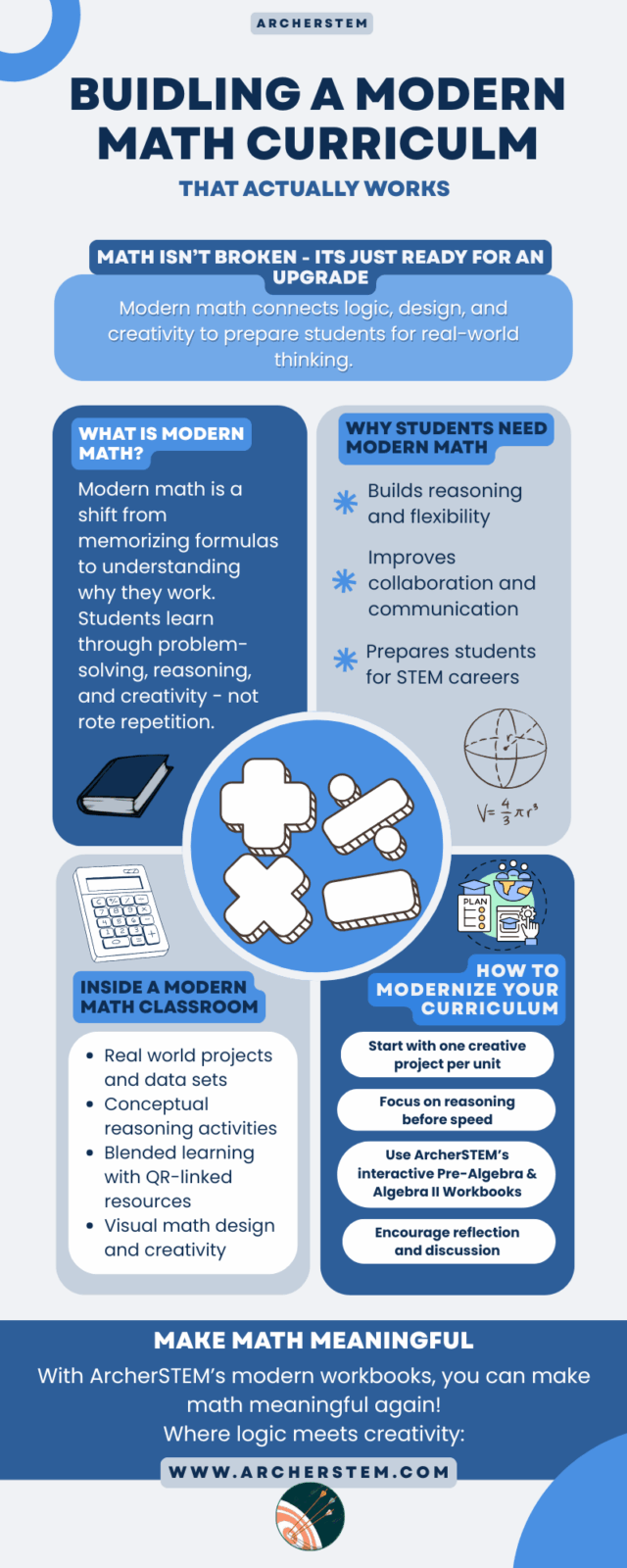
Why Modern Math Matters
A modern math curriculum doesn’t just focus on right answers; it focuses on how students arrive there. It blends logic with creativity, structure with real-world meaning.
The National Council of Teachers of Mathematics (NCTM) advocates that “mathematics instruction should connect to students’ experiences and interests” — because relevance drives retention. In other words, if students can’t relate to what they’re learning, they won’t retain it.
And the data supports that: a 2023 OECD study found that students who learn math through applied, real-world examples perform 23% better on long-term assessments and show higher motivation to continue STEM studies.
Modern math isn’t about “more problems per page” — it’s about giving math a pulse.
The Research Behind “Get More Math”
The phrase “get more math” doesn’t mean overload — it means depth over drill.
-
A Stanford Graduate School of Education study (Boaler, 2020) found that students in classrooms emphasizing conceptual reasoning — instead of rote memorization — were twice as likely to persist through advanced math levels.
-
The Hechinger Report (2023) noted that active learning models in math “increase student achievement by one to two letter grades compared with lecture-style instruction.”
-
EdWeek (2022) highlighted that schools integrating creativity and student voice into their math lessons saw a 45% jump in engagement and stronger performance on state assessments.
In short, modern math doesn’t look harder — it just feels smarter.
What a Modern Math Curriculum Looks Like
1. Real-World Application
Students should experience math through scenarios they care about — analyzing social media data, designing a small business budget, or mapping a sports statistic trend.
When learners see math used in familiar contexts, comprehension and curiosity grow simultaneously.
2. Visual + Interactive Design
Visual representations and hands-on models help students translate abstract equations into mental pictures. Tools like graphs, digital manipulatives, and QR-linked simulations bridge gaps in understanding — something OECD (2023) reports improves student problem-solving speed by 30%.
3. Collaborative Learning
Modern classrooms promote peer-to-peer problem-solving, not silent rows of worksheets. Research from NCTM (2021) shows that group-based mathematical discourse strengthens conceptual understanding and supports equity in learning outcomes.
4. Assessment for Thinking, Not Speed
Instead of testing how fast students can compute, modern assessment measures how well they can reason, explain, and justify. Schools that adopt open-ended performance tasks see significant improvement in student confidence and long-term retention.
How ArcherSTEM Brings Modern Math to Life
At ArcherSTEM, we’ve built our curriculum around this philosophy. Our Pre-Algebra and Algebra II Workbooks are filled with design-based problems, visual models, and QR-coded extensions that connect lessons to real life.
Students might solve a budgeting challenge one day and decode a pattern in music or architecture the next. Each page is designed to help them get more math — through color, context, and creativity.
When students understand why math matters, they stop asking “When will I use this?” and start asking, “What can I build with this?”
What the Data Says About Student Confidence
Confidence is the hidden variable in math success. Stanford University (Boaler, 2018) found that students who viewed math as flexible and creative — rather than fixed and procedural — scored significantly higher on assessments and reported lower math anxiety.
In ArcherSTEM classrooms, we’ve seen the same pattern: when students engage with modern, visual math, participation increases, and fear decreases. It’s not just about teaching formulas — it’s about rebuilding identity.
Closing Thoughts & CTA
Math is not about memorization; it’s about imagination. The world runs on equations — from the angles in your phone’s design to the algorithms behind your favorite apps. But for students to thrive, they need a curriculum that connects that logic to real life.
That’s what modern math is all about — helping learners see that every formula tells a story.
Ready to modernize your classroom?
Check out ArcherSTEM’s Pre-Algebra and Algebra II Workbooks — innovative, research-aligned resources that turn numbers into meaning and learners into thinkers.