Across the world, a new generation of learners is redefining success — not by waiting for jobs, but by creating opportunities through science, technology, engineering, and math.This movement, known as micro-entrepreneurship, blends creativity, coding, and financial literacy to empower students to build small, scalable ventures from their own ideas. At ArcherSTEM, we see micro-entrepreneurship as...
Teacher TrainingThe Rise of Micro-Entrepreneurship in STEM

Across the world, a new generation of learners is redefining success — not by waiting for jobs, but by creating opportunities through science, technology, engineering, and math.
This movement, known as micro-entrepreneurship, blends creativity, coding, and financial literacy to empower students to build small, scalable ventures from their own ideas.
At ArcherSTEM, we see micro-entrepreneurship as the next step in modern STEM education — where math meets money sense, coding meets creativity, and innovation becomes a habit.
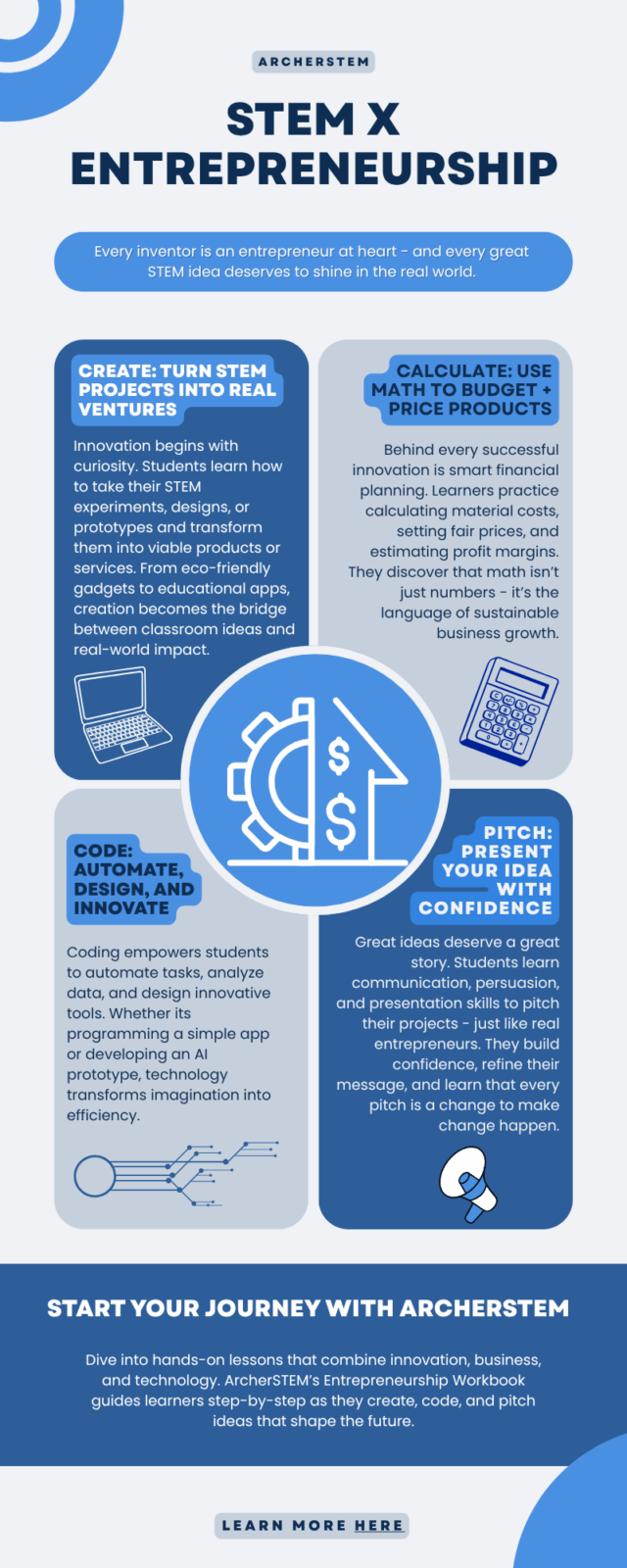
🔧 What Is Micro-Entrepreneurship?
Micro-entrepreneurship means launching small-scale, self-driven businesses or digital products with minimal startup costs. These projects often begin as class assignments, homeschool challenges, or passion projects — but they teach the same real-world skills that drive major innovations.
In STEM contexts, that might look like:
-
Building a math-based tutoring app using Python or Scratch.
-
Creating a budget tracker or financial quiz game for peers.
-
Designing eco-friendly prototypes in engineering or sustainability projects.
-
Selling digital STEM resources like infographics or flashcards.
Each of these ideas develops entrepreneurial thinking, financial awareness, and computational logic — key skills for the 21st-century learner.
💡 Why Micro-Entrepreneurship Belongs in STEM Education
STEM is about problem-solving, and entrepreneurship is about turning those solutions into impact.
When we merge the two, students begin to see how equations, coding, and experiments translate into real economic and social value.
Here’s what it builds:
-
Financial Literacy: Students learn costs, pricing, and profit margins by managing their own micro-ventures.
-
Critical Thinking: Projects require logic, iteration, and testing — the same skills used in scientific inquiry.
-
Confidence & Leadership: Every prototype or pitch presentation reinforces soft skills and creative agency.
-
Tech Fluency: Learners gain familiarity with digital tools, coding environments, and AI platforms.
In short, micro-entrepreneurship turns theory into tangible learning experiences.
💼 Real-World Examples
-
The Student Coder: A high-schooler builds a simple website that helps peers solve math problems and earns ad revenue.
-
The Green Innovator: A homeschool student launches a mini “eco-kit” business teaching others to recycle household waste.
-
The Teen Financier: A group of students use ArcherSTEM’s Financial Literacy Workbook to design an investment simulation game for their classmates.
Each project starts small — but the lessons in planning, budgeting, and creativity last a lifetime.
🧮 The Role of Math and Technology
Math is the universal language of both innovation and business. From calculating unit costs to optimizing design parameters, quantitative thinking powers every entrepreneurial idea.
Meanwhile, technology accelerates execution — coding tools, AI platforms, and digital workspaces make it possible for students to:
-
Automate tasks, create dashboards, or test prototypes online.
-
Collaborate remotely and share results instantly.
-
Use data analytics to measure progress and refine products.
When math and tech align, learners not only understand systems — they build them.
🚀 How ArcherSTEM Encourages Student Entrepreneurs
The ArcherSTEM LMS and Entrepreneurship 101 workbook give students a launchpad to practice these skills safely and creatively.
Here’s how:
-
Project-Based Modules: Students design and pitch small ventures using STEM logic and financial frameworks.
-
AI Tutoring: Automated feedback helps refine project plans, prototypes, and business ideas.
-
Interactive Lessons: Learners explore cost-benefit analysis, budgeting, and startup simulations.
-
Gamified Learning: Badges and achievements motivate consistent progress.
Whether you’re a teacher, homeschool parent, or program leader, ArcherSTEM provides the tools to turn STEM learning into real-world entrepreneurship.
🌟 Final Thoughts
Micro-entrepreneurship is more than a trend — it’s the future of STEM education. It teaches students to connect logic with creativity, independence with collaboration, and learning with leadership.
By fostering innovation early, we’re not just preparing students for careers — we’re helping them create them.
Ready to nurture the next generation of innovators?
Explore the ArcherSTEM LMS and Entrepreneurship 101 Workbook to help your learners start building real-world solutions today.