Intro: The New Age of Math Help Remember when “show your work” was the golden rule?Today, apps like Photomath, Symbolab, and ChatGPT can solve problems instantly — from Pre-Algebra to Calculus. Parents worry this means kids are cheating. Teachers panic that students won’t think critically anymore.But what if the real problem isn’t the solver —...
Teacher TrainingThe Truth About Math Solvers: How to Use Them to Actually Learn

Intro: The New Age of Math Help
Remember when “show your work” was the golden rule?
Today, apps like Photomath, Symbolab, and ChatGPT can solve problems instantly — from Pre-Algebra to Calculus. Parents worry this means kids are cheating.
Teachers panic that students won’t think critically anymore.
But what if the real problem isn’t the solver — it’s how we use it?
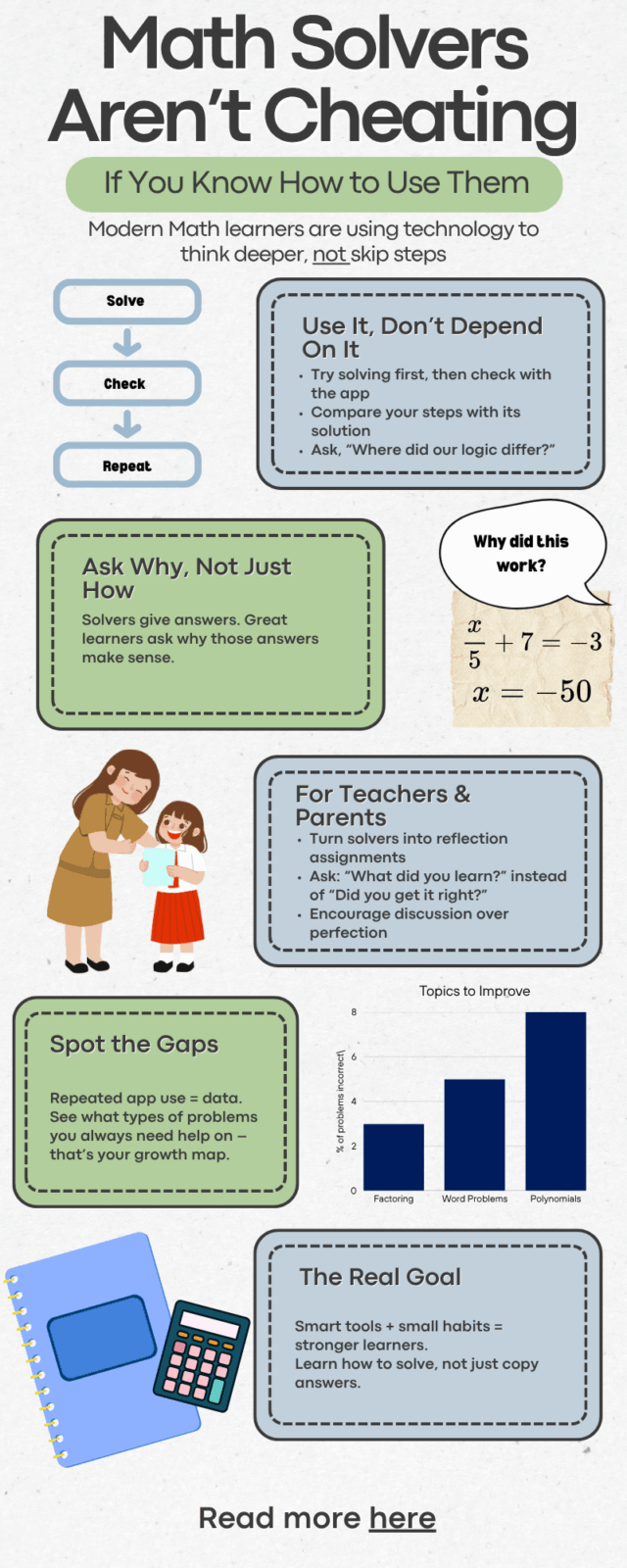
At ArcherSTEM, we’ve seen thousands of students lean on technology out of frustration, not laziness. They want to understand math — but they’re overwhelmed. So let’s talk about how to make these tools actually teach instead of replace learning.
1. Solvers Don’t Have to Be Shortcuts
A “math solver” sounds like a replacement for thinking, but it doesn’t have to be.
When used the right way, it’s like having a personal tutor who never gets tired.
Try this method:
-
Solve the problem yourself first.
-
Then check your steps with a solver.
-
Compare how it reached its answer.
This reflection builds stronger connections in your brain — and that’s what real math mastery looks like.
2. Focus on the Why, Not Just the How
Solvers are great at computation, but they can’t explain why something works. That’s your job.
If the app says the answer is 14, ask yourself:
-
Why was this equation linear instead of quadratic?
-
Why did distribution work here but not in another example?
The goal is to use the solver as a discussion partner — not a crutch.
3. Teachers and Parents Can Leverage Solvers Too
Instead of banning them, educators can assign “solver reflection” activities:
-
Step 1: Have students predict the answer.
-
Step 2: Let them use the app.
-
Step 3: Write a short paragraph on what they learned or misunderstood.
Parents can also ask, “How did the app explain it?” rather than just, “Did you get it right?”
When students verbalize their understanding, retention skyrockets.
4. Use Solvers to Spot Gaps
Solvers can expose patterns in what students don’t know.
If you’re always needing help on factoring, that’s a red flag.
If word problems trip you up, time to revisit algebraic reasoning.
Treat the solver like data — not magic. It’s feedback.
5. The Real Goal: Independence
At ArcherSTEM, we believe every tool should lead to more independence, not less.
Our Algebra 2 Workbook includes QR-coded examples and guided problem sets that help students think through each step — no blind copying required.
That’s the difference between memorizing and mastering.
Conclusion
Math solvers aren’t going anywhere. But with the right approach, they can make students sharper, not lazier.
It’s not about fighting technology — it’s about teaching with it.
If you want ready-to-use exercises that pair perfectly with modern math tools, check out our ArcherSTEM Algebra 2 Workbook.
Because learning math isn’t about avoiding mistakes — it’s about understanding them.