IXL Workbooks vs. Interactive Learning: Which One Really Works? When people talk about online learning tools, IXL is usually in the conversation. Parents, teachers, and students either love it for the drill-and-practice approach or roll their eyes at the endless questions. But here’s the real question: are IXL workbooks enough for deep learning, or do...
Teacher TrainingIXL Workbooks vs. Interactive Learning: Which One Really Works?
IXL Workbooks vs. Interactive Learning: Which One Really Works?
When people talk about online learning tools, IXL is usually in the conversation. Parents, teachers, and students either love it for the drill-and-practice approach or roll their eyes at the endless questions. But here’s the real question: are IXL workbooks enough for deep learning, or do students need something more interactive?
Why IXL Workbooks Are Popular
IXL became a household name because it focuses on:
- Practice questions: Thousands of them, across subjects.
- Personalized skill paths: Students can work at their level.
- Immediate feedback: You know right away if you’re wrong.
For parents, that feels like progress. For teachers, it’s an easy way to assign skills.
The Downsides of IXL Workbooks
Ask most students, and you’ll hear the same critiques:
- Repetitive practice: Feels like busy work after a while.
- Little real-world context: Great at “solving for x,” not great at explaining why it matters.
- Motivation dip: Many kids lose steam after too many practice drills without fun or creativity.
👉 Example: A student may master factoring quadratics on IXL but struggle to see how it connects to designing a business budget or solving coding problems.
Why Interactive Workbooks Work Better
That’s where interactive learning comes in. A workbook doesn’t just have to be “pages of problems.” It can be:
- Hands-on activities: Designing a budget, building a bridge, or analyzing credit scores.
- Gamified sections: Puzzles, mazes, QR codes, and real challenges.
- Cross-subject links: Showing how math ties into coding, financial literacy, or STEM careers.
When students see relevance, they care more. And when they care more, they learn better.
A Side-by-Side Comparison
| Feature | IXL Workbooks | Interactive Workbooks (like ArcherSTEM) |
| Practice | Heavy repetition | Targeted practice with variety |
| Real-World Context | Limited | Built into lessons (finance, coding, STEM) |
| Engagement | Drops over time | Boosted with games, activities, and projects |
| Flexibility | Aligned to skills | Aligned to standards and careers |
| Technology Use | Mostly online drills | QR codes, activities, tech integration |
How Teachers Use Both Together
Here’s the key: it doesn’t have to be either-or. Some schools use IXL for drilling basics, then interactive workbooks to apply those basics.
- IXL for fluency → Students get fast at solving.
- Interactive workbooks for mastery → Students see how solving actually applies to life.
What Parents Should Know
Parents often buy IXL subscriptions thinking it’ll fix math struggles. But a student who’s disengaged won’t suddenly fall in love with math just because of more practice. What makes the difference is:
- Context (why the math matters).
- Confidence (seeing progress beyond the screen).
- Creativity (letting kids solve in their own way).
Interactive workbooks fill those gaps.
Final Thoughts
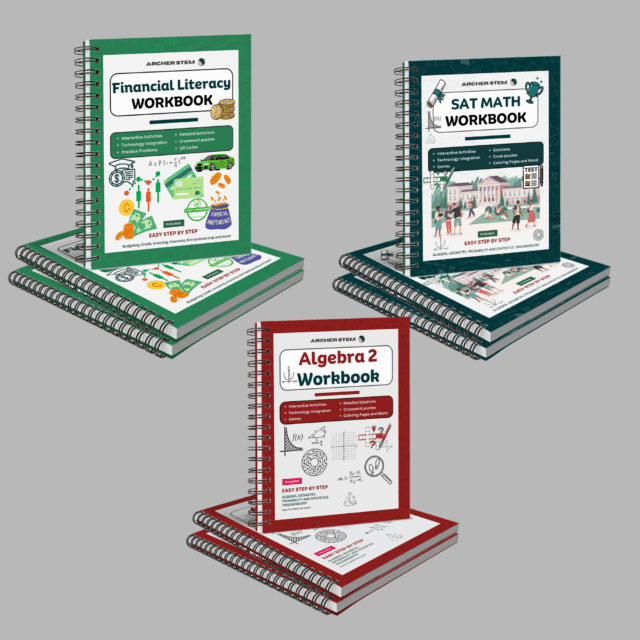
IXL workbooks aren’t bad — they’re just incomplete. Students need both practice and application. That’s why we built the ArcherSTEM series: Pre-Algebra, Algebra 2, SAT Math, Financial Literacy, Coding, and Entrepreneurship. Each workbook takes academic skills and connects them to projects, puzzles, and the real world.
👉 Want ready-to-use resources that go beyond drills? Check out our High School Bundle. It includes interactive workbooks designed to make students see the “why” behind the problems.