Is a College Degree Still Worth It in 2026? Let’s be honest. If you asked this question 10 years ago, the answer was simple:“Go to college or you’ll fall behind.” Today? Parents, students, and even schools are quietly asking: Is college still the smartest investment? The answer isn’t yes or no. It’s “it depends —...
Teacher TrainingIs a College Degree Still Worth It in 2026?
Is a College Degree Still Worth It in 2026?
Let’s be honest.
If you asked this question 10 years ago, the answer was simple:
“Go to college or you’ll fall behind.”
Today?
Parents, students, and even schools are quietly asking:
Is college still the smartest investment?
The answer isn’t yes or no.
It’s “it depends — and the data proves it.”
The Cost of College Has Changed Everything
According to the College Board:
-
Average annual cost of a public 4-year in-state college: ~$27,000
-
Private colleges average over $55,000 per year
-
Total cost for a 4-year degree can exceed $100,000–$220,000
(Source: College Board – Trends in College Pricing)
This isn’t just tuition — it includes housing, books, fees, and living expenses.
Student Loan Debt Is Now a Structural Issue
The Federal Reserve reports:
-
Total U.S. student loan debt exceeds $1.7 trillion
-
The average borrower graduates with ~$37,000 in debt
-
Many borrowers take 10–25 years to repay
(Source: Federal Reserve Bank of New York)
Debt delays:
-
Home ownership
-
Starting businesses
-
Saving for retirement
That’s not a personal failure — it’s math.
Degrees Still Pay — But Not Equally
According to the Bureau of Labor Statistics (BLS):
-
Median weekly earnings with a bachelor’s degree: ~$1,493
-
With only a high school diploma: ~$899
(Source: BLS, Education Pays)
But here’s the part people skip:
Earnings vary wildly by major.
-
Engineering, CS, healthcare → strong ROI
-
Many general degrees → slow or uncertain payoff
A degree alone doesn’t guarantee income anymore.
Employers Are Shifting Away From Degree Requirements
This is the biggest change.
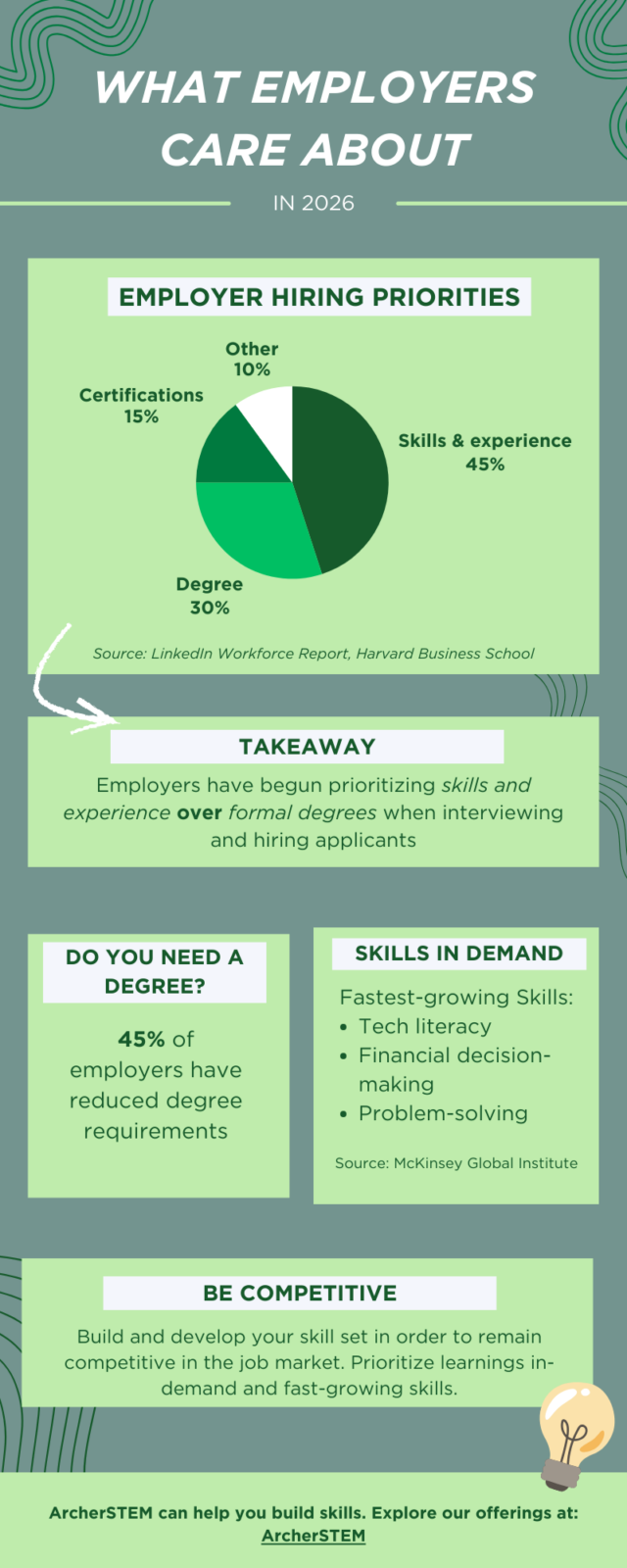
According to LinkedIn’s Workforce Report:
-
Over 45% of employers have reduced degree requirements for some roles
-
Skills-based hiring is growing fastest in tech, business, and operations
(Source: LinkedIn Economic Graph)
Even Google, IBM, and Apple no longer require degrees for many roles.
What Employers Actually Want Now
A Harvard Business School study found employers prioritize:
-
Applied skills
-
Problem-solving
-
Tech literacy
-
Communication
-
Financial decision-making
(Source: Harvard Business School – Burning Glass Institute)
In other words:
Degrees signal effort.
Skills signal readiness.
The Rise of Skills-Based Education
According to McKinsey & Company:
-
87% of companies report skill gaps in their workforce
-
Workers with adaptable skills advance faster than those with credentials alone
(Source: McKinsey Global Institute)
This explains the rise of:
-
Coding bootcamps
-
Financial literacy programs
-
Entrepreneurship education
-
Career-aligned certifications
So… Is College Still Worth It?
Here’s the honest answer:
College is worth it when:
-
It aligns with a clear career path
-
The ROI makes sense
-
Skills are developed alongside academics
College is not enough when:
-
Students graduate without practical skills
-
Debt outweighs earning potential
-
Financial literacy is missing
The future belongs to hybrid learners.
Why We Build Skills-First Resources at ArcherSTEM
We don’t tell students to skip college.
We tell them:
“Don’t outsource your future to one system.”
Our workbooks focus on:
-
Financial literacy
-
Coding fundamentals
-
Entrepreneurship
-
Math for real-world decisions
These skills support any path — college, career, or business.
College is no longer the finish line.
It’s one tool — not the plan.
The students who win?
-
Learn how money works
-
Build technical skills early
-
Understand careers before committing
That’s not anti-college.
That’s pro-reality.
Want skills students actually use — whether they go to college or not?
👉 College Survival Guide Workbook
https://archerstem.com/product/college-survival-guide-book/
Explore more: