If you’ve felt like schools have been talking a lot about “innovation” lately but nothing really changes in the classroom… you’re not imagining it. Education reform usually moves slowly. Very slowly. But recently, the U.S. Department of Education has been putting real money behind literacy, workforce skills, and career readiness — and that signals something...
Teacher TrainingUpdated Federal Education Innovation Grants: Literacy + Workforce Skills in Focus for 2026

If you’ve felt like schools have been talking a lot about “innovation” lately but nothing really changes in the classroom… you’re not imagining it.
Education reform usually moves slowly. Very slowly.
But recently, the U.S. Department of Education has been putting real money behind literacy, workforce skills, and career readiness — and that signals something important for students, parents, and educators heading into 2026.
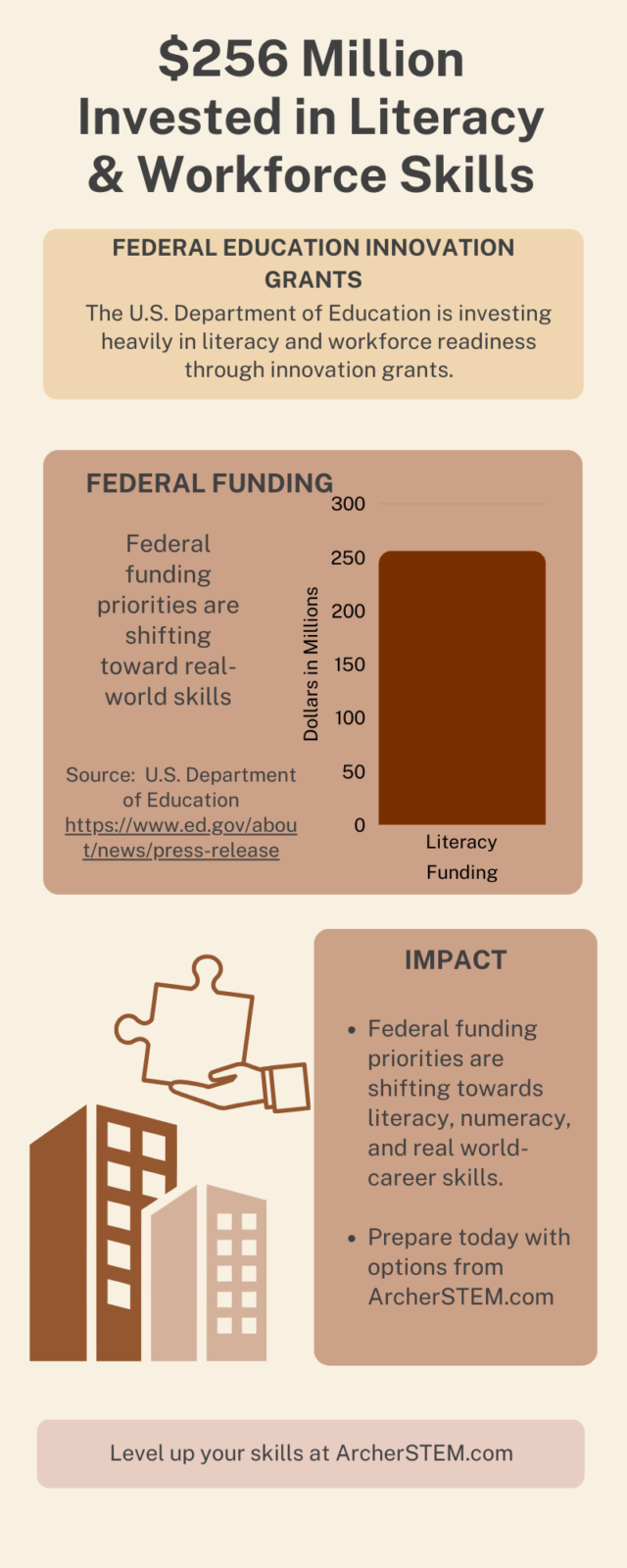
What the Department of Education Announced
The U.S. Department of Education recently announced hundreds of millions of dollars in Education Innovation and Research (EIR) grants, with a major focus on improving literacy outcomes nationwide.
One of the headline figures:
$256 million allocated specifically to literacy improvement initiatives.
These grants are designed to support:
- Evidence-based literacy instruction
- Innovative learning models
- Programs that improve student outcomes at scale
Source:
https://www.ed.gov/about/news/press-release
This isn’t just funding for reading comprehension. It’s part of a broader push to align literacy, numeracy, and workforce readiness.
Why Literacy Is Being Prioritized First
Here’s the uncomfortable truth.
If students struggle to read, interpret information, or analyze data, everything else breaks down — including financial literacy, STEM learning, and career readiness.
National data consistently shows:
- Declining reading proficiency in upper elementary and middle school
- Widening achievement gaps post-pandemic
- Students advancing grades without mastering fundamentals
That’s why literacy has become ground zero for reform.
The Department of Education is treating literacy as the foundation skill that supports:
- Career pathways
- Postsecondary success
- Financial decision-making
- Workforce training
Where Workforce Skills Fit In
Alongside literacy grants, the Department of Education has also expanded initiatives tied to:
- Workforce development challenges
- Career-connected learning
- Talent marketplace funding
- Postsecondary credential pathways
The message is clear:
Education is being reframed around real-world outcomes.
Students aren’t just expected to “know things.”
They’re expected to apply them.
That includes:
- Understanding paychecks
- Managing money
- Interpreting contracts
- Using math in real scenarios
- Thinking logically and critically
What This Means for School Districts
For districts, these grants create opportunities — but also pressure.
Districts that receive funding are expected to:
- Show measurable outcomes
- Use data-driven instruction
- Adopt scalable, proven resources
- Align instruction with workforce needs
That’s why many schools are looking beyond traditional textbooks and toward practical, skills-based curriculum.
And it’s why supplemental resources are playing a bigger role than ever.
Why Literacy, Math, and Money Skills Are Connected
This is where things finally start to click.
You can’t teach financial literacy without:
- Reading comprehension
- Numeracy
- Logical reasoning
You can’t teach career readiness without:
- Problem-solving
- Applied math
- Decision-making skills
That’s why ArcherSTEM builds resources that connect these skills instead of isolating them.
Strong math foundations like Pre-Algebra and Algebra 2 support:
- Budgeting
- Percentages and interest
- Data interpretation
- Financial modeling
👉 Explore foundational math resources here:
https://archerstem.com/product/pre-alg-workbook/
https://archerstem.com/product/alg-2-workbook/
Where Financial Literacy Fits Into Federal Priorities
Although financial literacy isn’t always named directly in federal grant titles, it sits at the intersection of every priority being funded:
- Literacy
- Workforce alignment
- Postsecondary readiness
- Economic mobility
As districts adopt new literacy and workforce programs, families who already support financial literacy at home give students a clear advantage.
That’s where structured, interactive tools matter.
👉 Want hands-on activities that teach budgeting, credit, and real-world money skills?
Explore the Financial Literacy Activity Workbook:
https://archerstem.com/product/financial-literacy-activity-workbook/
What Parents and Educators Should Watch Next
Heading into 2026, expect to see:
- More district-level curriculum shifts
- Increased emphasis on measurable skills
- Expanded use of data-driven tools
- Stronger alignment between academics and life skills
Federal funding doesn’t change classrooms overnight — but it sets the direction.
And the direction is clear:
Education must prepare students for real life.
Why I’m Paying Attention to This Shift
I watch these funding announcements closely because they confirm what families already feel.
Students don’t need more theory.
They need clarity. Practice. Confidence.
That’s why ArcherSTEM focuses on ready-to-use, practical workbooks that support literacy, math, and financial understanding together.
When schools start moving this way, families who’ve already started are ahead.
Explore ArcherSTEM Resources
- Shop All Workbooks: https://archerstem.com/shop
- Financial Literacy Activity Workbook: https://archerstem.com/product/financial-literacy-activity-workbook/
- High School Bundle: https://archerstem.com/product/high-school-bundle/
- SAT Math Workbook: https://archerstem.com/product/sat-math-workbook/