Let’s start with a simple question most parents are quietly asking right now: Why is everyone suddenly talking about financial literacy in schools? For years, money education was treated like a bonus. Something students would “pick up later.” But later has proven to be expensive. Student debt. Credit card debt. Confusion around taxes, rent,...
Money & Personal FinanceNew Financial Literacy Laws: What Parents and Students Need to Know

Let’s start with a simple question most parents are quietly asking right now:
Why is everyone suddenly talking about financial literacy in schools?
For years, money education was treated like a bonus. Something students would “pick up later.”
But later has proven to be expensive.
Student debt. Credit card debt. Confusion around taxes, rent, loans, and basic budgeting.
All of it has exposed a gap in the education system — and states are finally responding.
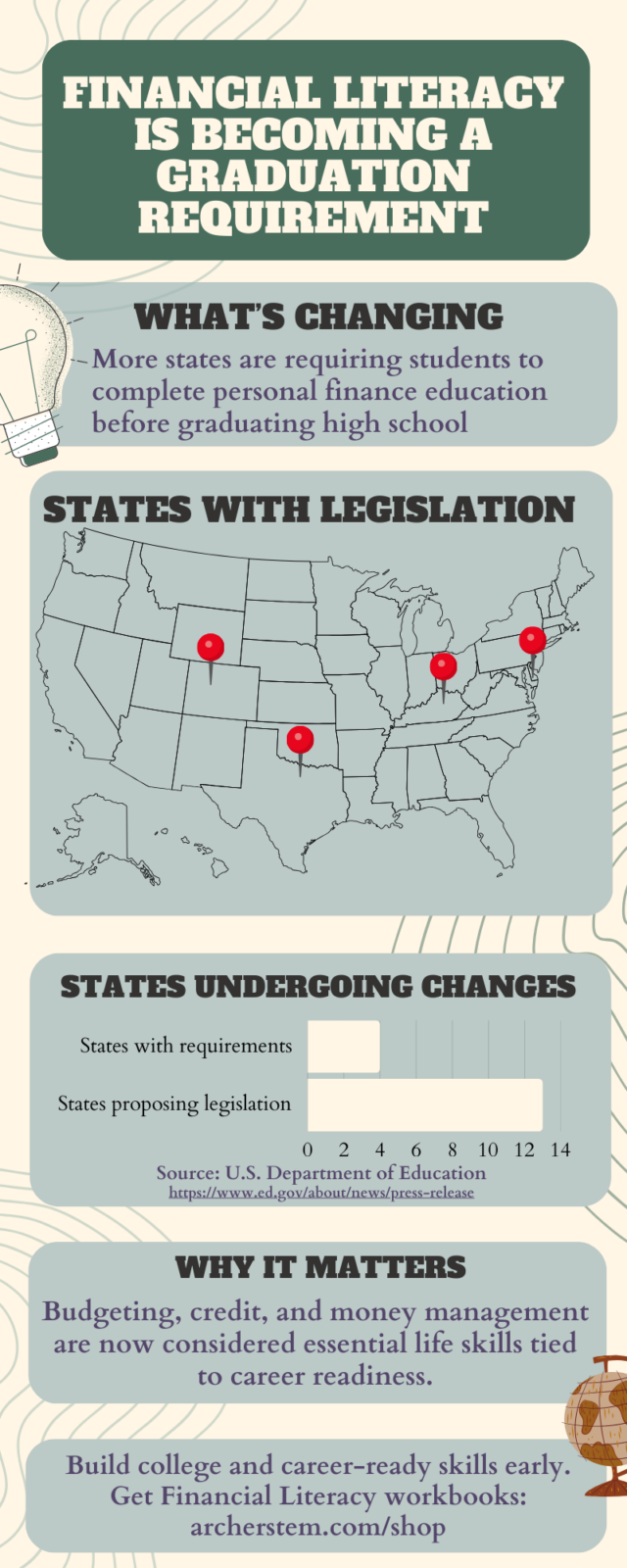
In 2025, financial literacy is becoming a graduation requirement in more states than ever before, and this shift is changing how schools define readiness for adulthood.
What’s Actually Changing in U.S. Schools
Across the country, states are passing or proposing legislation that requires students to complete personal finance education before graduating high school.
According to the National Endowment for Financial Education (NEFE), states such as Kentucky, Colorado, Delaware, Hawaii, Maine, and others are actively working to implement financial literacy requirements in public schools.
In many cases, these laws require:
- A stand-alone personal finance course
- Coursework that counts toward graduation
- Explicit instruction in budgeting, credit, saving, and money management
This isn’t a pilot program anymore. It’s a structural shift.
Why States Are Pushing Financial Literacy Now
The reason is simple:
Too many students are graduating without life-ready skills.
Research consistently shows that adults with low financial literacy:
- Pay more in interest and fees
- Carry higher levels of debt
- Delay major life milestones
- Experience higher financial stress
Yahoo Finance reports that financial illiteracy costs individuals thousands of dollars over a lifetime due to avoidable mistakes.
Source:
https://finance.yahoo.com/news/annual-nfec-survey-poor-financial-130500813.html
States aren’t reacting to trends — they’re reacting to outcomes.
Stand-Alone Courses Are Becoming the Standard
One important detail parents should know:
Many of these new laws require stand-alone financial literacy courses, not just “sprinkling money topics” into math or economics classes.
This matters because:
- Dedicated courses allow time for real-world application
- Students can practice decisions, not just memorize terms
- Financial literacy becomes intentional, not incidental
NEFE also notes that some states are working to professionalize teacher training, ensuring educators are properly equipped to teach financial concepts.
What This Means for Parents and Students
If your child is currently in middle school or high school, there’s a strong chance:
- Financial literacy will soon be required in their state
- Money skills will factor into graduation criteria
- Career readiness will include financial understanding
But implementation takes time.
And not every district rolls these programs out equally.
That’s where families often step in.
Why Financial Literacy Can’t Be Passive
Here’s the part schools still struggle with.
Financial literacy isn’t something students learn by listening.
They learn it by doing.
That means:
- Practicing budgeting with real numbers
- Comparing interest rates
- Understanding paychecks and deductions
- Seeing how small decisions compound
That’s exactly why ArcherSTEM created its Financial Literacy Activity Workbook — to give students hands-on practice, not just theory.
👉 Want ready-to-use worksheets that help students apply money skills in real life?
Explore the workbook here:
https://archerstem.com/product/financial-literacy-activity-workbook/
Why Math Foundations Still Matter
Money skills rely heavily on numeracy:
- Percentages
- Ratios
- Functions
- Logical reasoning
If students struggle with foundational math, financial concepts become harder to grasp.
That’s why many families pair financial literacy with strong math support, like Pre-Algebra and Algebra 2, to reinforce confidence and comprehension.
You can explore the full High School Bundle here:
https://archerstem.com/product/high-school-bundle/
The Bigger Picture: Education Is Catching Up to Life
The rise of financial literacy graduation requirements signals something important:
Schools are being forced to admit what families already knew.
Academic success without life skills isn’t enough.
This shift benefits:
- Students entering college
- Students entering the workforce
- Homeschool families seeking structure
- Parents who want transparency
Financial literacy isn’t political.
It’s practical.
Explore ArcherSTEM Resources
- Shop All Workbooks: https://archerstem.com/shop
- Financial Literacy Activity Workbook: https://archerstem.com/product/financial-literacy-activity-workbook/
- High School Bundle: https://archerstem.com/product/high-school-bundle/