Breaking Loops: How Math Improves Your Problem-Solving Skills You ever notice how most arguments online go in circles?Someone says “X,” another person says “Y,” then ten minutes later, we’re back at “X” again—but louder this time. That’s what I call a logic loop, and it’s one of the biggest clues that someone skipped math class....
Math & Problem SolvingBreaking Loops: How Math Improves Your Problem-Solving Skills

Breaking Loops: How Math Improves Your Problem-Solving Skills
You ever notice how most arguments online go in circles?
Someone says “X,” another person says “Y,” then ten minutes later, we’re back at “X” again—but louder this time.
That’s what I call a logic loop, and it’s one of the biggest clues that someone skipped math class.
No, seriously—math isn’t just numbers and formulas. It’s how to think. It’s the mental gym that trains your brain to spot patterns, build logical arguments, and escape those endless debate loops that make your head hurt.
Let’s break it down.
🧮 The Hidden Language of Problem Solving
According to the National Council of Teachers of Mathematics (NCTM, 2024), mathematical reasoning builds structured decision-making. Every proof, every problem set, and every equation forces you to slow down and ask:
-
What are the givens?
-
What am I trying to prove?
-
What’s the best path from A to B?
That’s not just math—that’s life strategy.
When you budget, run a business, or manage a team, you’re doing the same thing: identifying knowns, defining unknowns, and mapping solutions. The brain that can do that in Algebra is the same brain that can handle real-world chaos.
Why Set Theory Matters More Than You Think
Most people never realize how much set theory (the study of relationships between groups or categories) shapes the way we argue and reason.
At its core, set theory asks: Who belongs where? What overlaps? What doesn’t?
Think of it like this:
-
All dogs are animals.
-
Some animals are pets.
-
Therefore, some dogs are pets.
Simple, right? But that same logic can prevent massive reasoning mistakes in real-life debates. When you understand how sets overlap—or don’t—you stop confusing correlation with causation, opinion with evidence, and emotional reaction with truth.
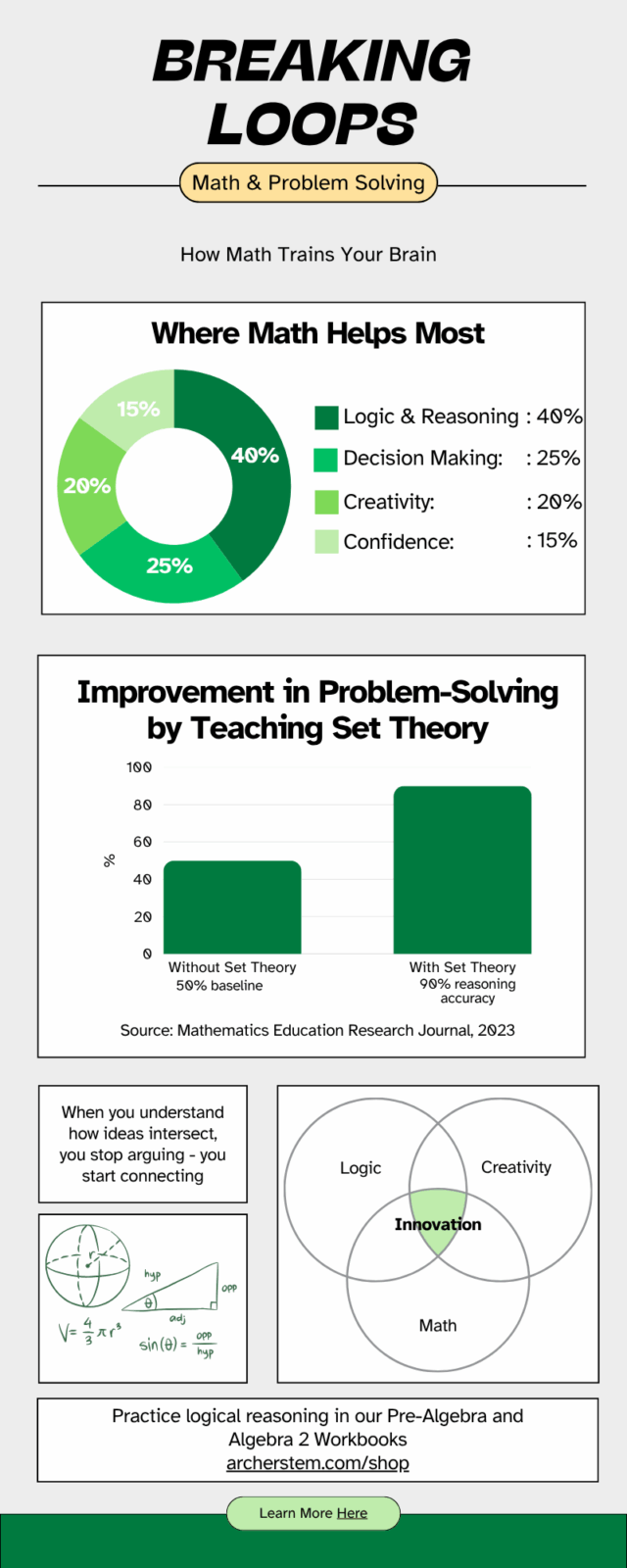
According to Mathematics Education Research Journal (2023), early exposure to set reasoning improves students’ ability to evaluate arguments and identify logical fallacies by over 40%.
In other words, understanding how ideas intersect teaches you how to think clearly, not just how to calculate.
Math as an Anti-Anxiety Framework
A 2023 Harvard Mind, Brain, and Education study found that learning mathematical reasoning actually reduces anxiety. Why?
Because it gives structure to uncertainty.
When you hit a problem—academic or personal—your brain wants order. Math offers that order through pattern recognition and logical mapping. Instead of spiraling (“This will never work”), a trained mind says, “Okay, what are my variables? What’s within my control?”
That’s literally algebraic thinking applied to life.
How Math Shapes Argument Skills
Let’s get practical for a second.
Here’s how math helps you build airtight reasoning in any argument, classroom or conversation:
1️⃣ Identifying Assumptions
-
In math: You state your givens before solving.
-
In argument: You name your premises before debating.
2️⃣ Avoiding False Equivalency
-
In math: You can’t divide by zero.
-
In argument: You can’t compare things that have no logical relation.
3️⃣ Testing Hypotheses
-
In math: You test examples until your pattern holds.
-
In argument: You stress-test ideas for consistency.
4️⃣ Drawing Conclusions Logically
-
In math: Q.E.D. (what was to be demonstrated).
-
In argument: Summarize how your evidence leads to your claim.
That’s why debaters, engineers, and entrepreneurs often sound similar—they’re all using the same structured reasoning playbook.
The Math of Innovation
Here’s the fun part: logic doesn’t kill creativity; it fuels it.
Every groundbreaking inventor, artist, and business owner uses mathematical reasoning—even if they don’t realize it. They identify constraints, analyze patterns, and imagine new combinations.
As Stanford University’s Center for Teaching and Learning (2024) noted, creativity is the product of “divergent thinking within defined logical boundaries.”
In other words: the rules give your ideas shape.
Einstein said it best:
“Pure mathematics is, in its way, the poetry of logical ideas.”
🧰 Try This Mini Lesson: Sets & Arguments
Let’s make this tangible. Grab a pen.
| Set | Description | Example |
|---|---|---|
| A | People who study math | {Alex, Maya, Jordan} |
| B | People who argue online | {Jordan, Chris, Priya} |
| A ∩ B | People who do both | {Jordan} |
See what happened there?
Jordan belongs to both sets—so if someone says, “All people who argue online are bad at math,” you instantly know that’s false. Set A intersects with Set B.
That’s how logic disarms bias.
Now apply that thinking to bigger questions:
-
Which ideas overlap between science and art?
-
Where do financial literacy and entrepreneurship intersect?
-
How can technology amplify, not replace, creativity?
When you see the world through sets, you stop generalizing and start connecting.
Want ready-to-use lessons that make logic and reasoning come alive?
Explore our Pre-Algebra Workbook, Algebra 2 Workbook, and Financial Literacy Workbook at ArcherSTEM.com.