I still remember the first time I realized money had a rhythm. I was in college, trying to make my $50 stretch across textbooks, food, and late-night coffee runs. I’d open my banking app like it was a video game — watching the numbers drop with every “move.” That’s when it hit me: money is...
Coding & TechnologyMoney & Personal FinanceWhy Financial Literacy Is the New Tech Skill (and a Smart Way to Make Money Fast)

I still remember the first time I realized money had a rhythm. I was in college, trying to make my $50 stretch across textbooks, food, and late-night coffee runs. I’d open my banking app like it was a video game — watching the numbers drop with every “move.” That’s when it hit me: money is math in motion.
Today, we talk about learning to code, building apps, and mastering AI — but understanding how money flows is just as vital. Financial literacy isn’t some side elective anymore; it’s the next tech skill every student needs.
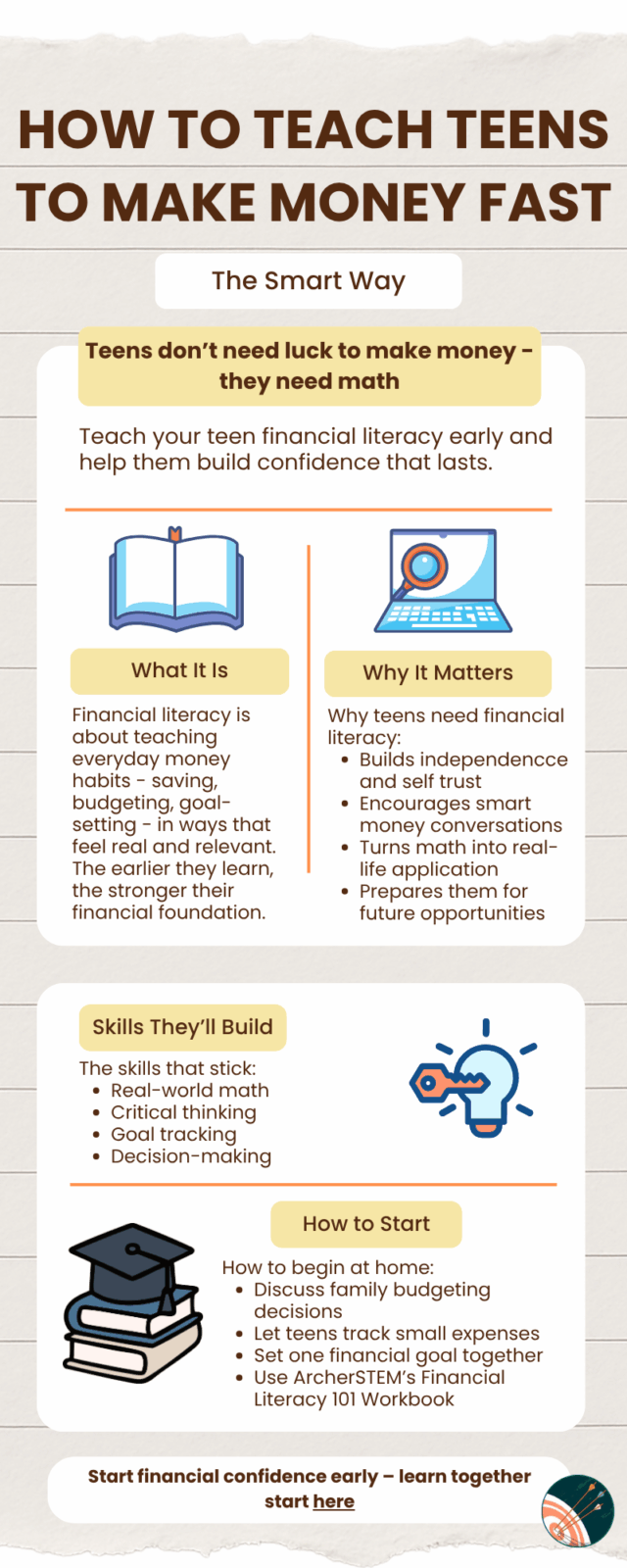
Tech Skills Are Math. So Is Money.
Let’s be real — both coding and budgeting require logic, pattern recognition, and problem-solving. According to the National Council on Economic Education, only 57% of U.S. high-school students are required to take a personal-finance course (EdWeek 2024). That means nearly half are graduating without ever learning how interest, debt, or taxes actually work.
At Archer STEM, we see financial literacy as a form of STEM fluency — a way to get more math in context. Students learn percentages through budgeting, data analysis through expense tracking, and even compound growth through investment simulations.
Example: When students calculate interest on a loan, they’re doing the same exponential math behind computer algorithms.
How Financial Literacy Teaches You to Make Money Fast — The Smart Way
Here’s the thing: you can’t “hack” wealth if you don’t understand its logic. “Making money fast” is really about identifying patterns, analyzing risk, and moving strategically — skills shared by entrepreneurs and programmers alike.
Financial literacy isn’t just saving — it’s system design. You learn to debug bad spending habits, optimize your inputs (income), and refactor your budget for efficiency.
A 2023 study by the FINRA Foundation found that young adults with financial-education experience are 80% more likely to save consistently and twice as likely to invest. That’s not luck — that’s literacy in action.
From Coding to Cash Flow — Math Is the Common Language
Both programming and personal finance teach you to think logically. They force you to break down big problems into smaller steps and measure outcomes. In our Financial Literacy 101 and Entrepreneurship 101 workbooks, students treat financial decision-making like an algorithm — input, process, output.
-
Input: Earnings or income
-
Process: Budget, save, invest
-
Output: Profit or growth
Once students see money as data, they start playing the game better. They’re not just learning how to budget — they’re learning how to build systems that make money work for them.
Building Financial Confidence Through Curriculum
Financial literacy is no longer optional. The College Board and state standards are pushing for integrated personal-finance curricula within STEM tracks (National Endowment for Financial Education Report, 2024). That’s why our curriculum at Archer STEM blends real-world math with financial logic — so students can see how their numbers translate into choices.
When students see how a $5 coffee every day turns into $1,200 a year, math suddenly feels real. And when they design a budget for a mock business, they learn that every equation has a human impact.
Final Thoughts & CTA
I built these workbooks because I wanted students to feel empowered — to see that math isn’t something that happens to you; it’s something you control.
Want to help students master the math of money? Check out our Financial Literacy 101 Workbook — a complete curriculum that turns numbers into real-world confidence.