When Algebra Finally Clicked When I first started tutoring high school students in algebra, I realized most didn’t actually hate math — they just hated being confused. The moment they understood how to isolate a variable or balance an equation, their faces lit up like they’d just solved a mystery. That’s the moment I knew:...
Math & Problem SolvingWhen Algebra Finally Clicks: Turning Equations into Confidence
When Algebra Finally Clicked
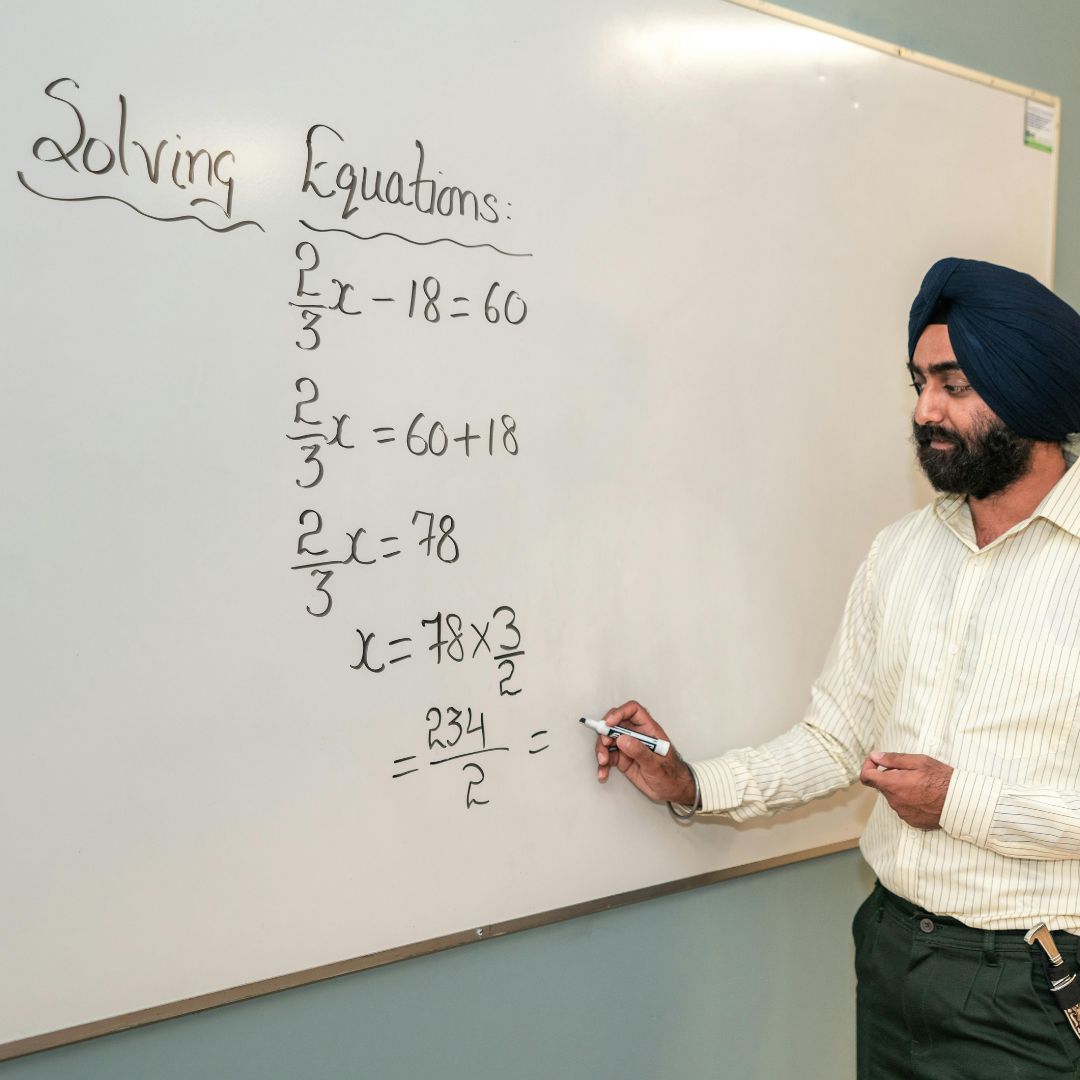
When I first started tutoring high school students in algebra, I realized most didn’t actually hate math — they just hated being confused. The moment they understood how to isolate a variable or balance an equation, their faces lit up like they’d just solved a mystery. That’s the moment I knew: algebra isn’t about memorizing formulas — it’s about learning how to think.
I remember one student, Maya, who told me, “I just can’t do equations.” She’d look at something like 2x + 5 = 15 and freeze up. But once I broke it down like a puzzle — subtract 5 from both sides, then divide by 2 — she solved it herself. That one “aha” moment built the confidence that changed everything.
Why Algebra Matters (Beyond the Test)
Algebra isn’t just a high school requirement. It’s a life skill.
Think about it — whenever you budget, adjust a recipe, or calculate a car payment, you’re applying algebraic reasoning. The ability to manipulate unknowns and find relationships between quantities helps you in everything from science to business.
In fact, research from Brookings and Education Week found that students who perform well in algebra are twice as likely to pursue STEM-related college majors. That’s not just correlation — it’s evidence that algebra builds cognitive muscles that pay off for life.
The Problem: Memorization Over Understanding
Too often, classrooms focus on repetition — solving for x fifty times — without context. But students don’t retain skills when they can’t see the “why.”
In one of my Algebra 2 workshops, I used an activity called The Missing Receipt Challenge. Students had to figure out who owed what after a group dinner using linear equations. The engagement skyrocketed because suddenly, the math was the solution to a real problem — not just numbers on a page.
This is exactly why ArcherSTEM’s Algebra 2 Workbook focuses on concept before calculation. Every unit starts with a relatable hook — a budgeting scenario, travel distance, or gaming leaderboard — that introduces algebraic thinking before moving into symbolic equations.
Breaking Down the Basics (Step-by-Step)
If you’ve ever said, “I don’t get algebra,” try this mindset shift:
-
Start simple: Every complex equation starts as a basic one. Example: 3x = 9 → Divide both sides by 3 → x = 3.
-
Balance is everything: Whatever you do to one side, you do to the other. It’s the golden rule of algebra — the scales must stay even.
-
Use real-world analogies: Think of solving for x as finding missing ingredients in a recipe. You know the total calories; you just need to figure out which part makes it add up.
-
Check your work visually: Substitute your solution back into the equation to verify it makes sense.
The Power of Visual Learning
Visual learners often thrive when algebra isn’t just numbers. That’s why our workbook integrates color-coded steps, graphing visuals, and QR codes that link to short digital tutorials. Students can scan, watch a 2-minute explainer, then apply what they’ve learned directly to a practice page.
When I introduced QR-linked examples, students who used to zone out started asking deeper questions like, “Wait, why do the slopes look different when we flip the equation?” That’s the curiosity that turns math fear into math fluency.
Algebra Beyond the Classroom
What many parents don’t realize is that algebra quietly drives innovation everywhere:
-
Technology: Algorithms and coding rely on algebraic logic.
-
Finance: Interest rates, savings growth, and ROI formulas are algebraic at their core.
-
Architecture & Design: Blueprint scaling and spatial relationships require algebraic reasoning.
At ArcherSTEM, we treat algebra as the foundation for all higher-order problem solving — not a standalone subject.
Common Mistakes Students Make
Here are a few mistakes I see over and over again:
-
Skipping steps: Students try to jump from 2x + 3 = 11 straight to an answer without isolating terms properly.
-
Sign errors: Forgetting that subtracting a negative flips the operation.
-
Losing track of variables: Writing sloppy equations and losing the thread mid-solution.
To fix this, our workbook includes “Error Detective” sections — pages filled with intentionally wrong solutions. Students must find and correct the mistakes, which trains them to slow down and think critically.
What I Learned from Teaching Algebra
After years of working with students, I realized something powerful: algebra teaches patience, logic, and creativity. It’s not about speed — it’s about clarity.
When students say, “I get it now,” that moment of empowerment reminds me why I built the ArcherSTEM Algebra 2 Workbook. It’s more than equations — it’s a bridge to confidence.
So if you’ve got a student (or you’re a parent/teacher) struggling to make algebra click, check out the Algebra 2 Workbook by ArcherSTEM — built for visual learners, creative thinkers, and anyone who wants to finally feel confident in math.
Key Takeaway
Algebra is less about solving for x and more about solving for yourself. Once you realize that, you’ll never look at equations the same way again.